Related Posts Plugin for WordPress, Blogger...
Showing posts with label Kentucky Derby. Show all posts

Saturday, May 5, 2012

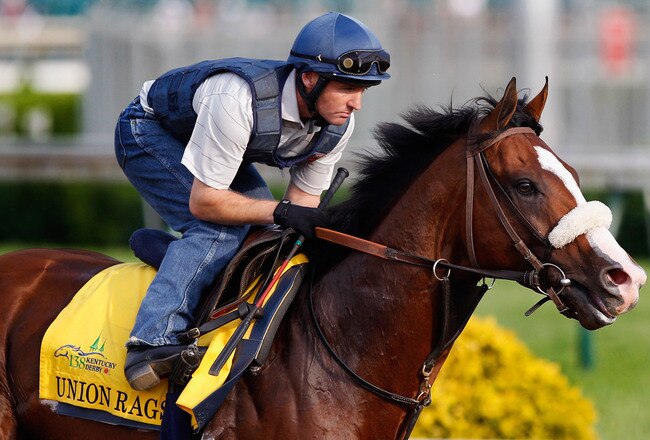
Union Rags has look of a champion but has to prove IT


Were he a human athlete, he'd be that guy a team would want coming off the bus first -- the kind who reeks of powerful presence both in his physical makeup and mental focus.
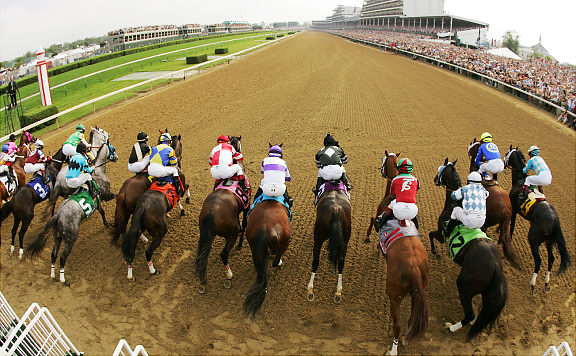
Even if the connections of his 19 other competitors aren't conceding any part of the 138th Kentucky Derby to Union Rags, the universal opinion regarding the son of Dixie Union is he has the look of a horse who knows he's something special.
Whether or not he backs that up with his effort in the 11/4-mile classic Saturday, Union Rags has already proven exceptional in his ability to inspire confidence even when he shows chinks in his armor.

Union Rags has lost two of his last three starts -- first when he ran second to eventual champion Hansen in the Breeders' Cup Juvenile at Churchill Downs last November and more recently when he took third as the heavy favorite in the Grade I Florida Derby at Gulfstream Park on March 31.
Even after those defeats, Union Rags is regarded by many as the one to beat in the first leg of the Triple Crown and would have been the morning-line favorite had Bodemeister not been so dominant winning the Arkansas Derby by 91/2 lengths on April 14.
As much as Thoroughbred racing is a what-have-you-done-for-me-lately environment, it is also a sport that can produce ample excuses when things go awry.
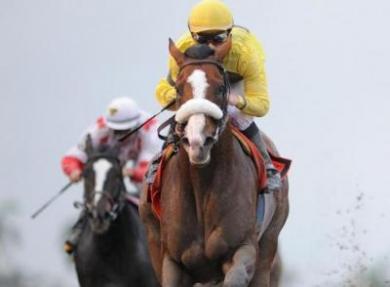
In the Breeders' Cup, an extremely wide trip throughout was seen as the culprit for Union Rags' defeat by a head -- the lone loss in his four-race juvenile campaign. When Take Charge Indy finished 11/4 lengths in front of Union Rags in the Florida Derby, some thought the fact the bay colt was kept off the pace behind tepid fractions on a track that favors speed was too much to overcome regardless of talent.
"I think everyone knows he's a good horse," said trainer Michael Matz, who saddled Barbaro to victory in the 2006 Kentucky Derby. "The two races that he lost, they obviously know there was a problem, whether he got shuffled wide or get hemmed in.
"It was a length and a half that cost him two Grade I's, $1.2 million and an Eclipse Award, but there's nothing you can do about it," Matz said. "I'll settle for the consolation prize. If they told me which I had to choose from the Breeders' Cup or the Derby, I'll take that."
Much of the reason Phyllis Wyeth's colt has been forgiven for his bobbles is how striking he looked in his winning efforts and how much he stands out physically from many of his class.
His 71/4-length victory in the Grade II Saratoga Special last August still ranks as his most gaudy winning margin, but it was Union Rags' third career start in the Grade I Champagne Stakes last October that had people thinking the Breeders' Cup would be his coronation.
In that outing, he went from being hopelessly stuck behind horses to a 51/4-length win in a matter of strides. When he made his season debut this February in the Grade II Fountain of Youth Stakes, Union Rags again was able find another gear without breaking a sweat, winning that 11รข „16-mile test by 4 lengths in his typical off-the-pace style.

"It's been amazing, the further he goes the stronger he gets," said Matz, whose only other Derby starter since Barbaro has been Visionaire, 12th in 2008. "He's really matured physically and mentally. I've had one great horse in Barbaro and I think I might have a second one."
Both around the barn and on the track, Union Rags gives off a rarefied air, so much so that his owner had seller's remorse after initially parting with the colt for $145,000 at 2010 Fasig-Tipton Saratoga Sale.
Wyeth, the wife of famed artist Jamie Wyeth, says she had a vivid dream of her colt becoming a stakes winner and subsequently ponied up $390,000 to get her boy back.
"I really did have that dream. I said, 'How could I have sold him? That was a big mistake," Wyeth said in March. "He was so gorgeous and his temperament was so wonderful."
As much as his well-balanced build and smooth-as-silk stride contribute to Union Rags' aptitude, so too does his mature mind. He will need it in order to take care of himself in the most challenging race of his life, one his connections hope will not necessitate the need to find excuses for him.
"You can always train them as hard as you want to up to a race and hopefully you've done enough," Matz said. "It's exciting for me to be back again with a horse that really has a chance to win the Kentucky Derby if not the Triple Crown. And it's an exciting time for Phyllis. She's never had a horse like this."

Mint juleps, 5 ways for Derby Day


Ah, the mint julep. One of the oldest, most revered and hotly debated fixtures of the drinking world. The name originates from the Arab word "julab," which was likely a medicinal rose water concoction. The modern-day mint julep, however, came about in the early 1800s. Frederick Marryat captured the mint julep best in 1839's A Diary in America:
"I once overheard two ladies talking in the room next to me, and one of them said, 'Well, if I have a weakness for any one thing, it is for a mint julep' - a very amiable weakness, and proving her good sense and good taste. They are, in fact, like American ladies, irresistible."
So, what is a mint julep? Simply: a drink of cognac, whiskey, or rum; sweetened with sugar, iced and flavored with fresh spearmint. A highly ritualistic tipple, I'll leave you to judge which is best.

For each, follow these basic julep preparation guidelines:
In a pre-chilled glass or julep cup, add the syrup and mint leaves. Muddle lightly, just to release the oils. Discard the bruised mint, half pack the glass with crushed ice, pour on the base spirit, stir to chill and top with more crushed ice. Garnish with a bunch of fresh spearmint, stems cut up to the leaves.
That said, I present you with a collection of five juleps, from the contemporary to the classic.
1. Siro's Ginger Julep (Kyle Ford, 2012)
- 2 oz bourbon
- 1/2 oz cognac
- 1/2 oz ginger syrup
- 6 spearmint leaves
- Candied ginger, garnish

"At Siro's, we wanted to present an iconic julep with a unique twist. Spicy ginger pairs beautifully with a high rye bourbon whiskey. Our julep is further elevated with a touch of cognac, in a nod to the drink's origin."
2. Peach Thunderbolt Julep (Charles H. Baker, Jr., 1939)
- 3 oz gold rum
- 1/2 oz fresh lime juice
- 1/2 oz simple syrup
- 1 peach (peeled, stoned, quartered, added with rum)
- 6 spearmint leaves

"The Peach Thunderbolt is named just as much for its effect as it is a place just south of Savannah. While bourbon with peach would be a no-brainer, the Thunderbolt uses instead gold rum. Mixed with fresh lime, mint and peach, this is a sip worthy of old Georgia."
3. Manila Hotel Julep (Monk Antrim, 1926)
- 2 1/2 oz bourbon or rye whiskey
- 2 teaspoons rum float
- 1/2 oz simple syrup
- 6 spearmint leaves
- 4 cherries, garnish
- 1 ripe pineapple stick, garnish

"This julep was discovered by Charles H. Baker in his travels to Manila during American Prohibition, great proof of the drink's popularity and reach. The float of rum and additional fruit garnish make this julep quite delectable."
4. Prescription Julep (Quackenboss, M.D., 1857)
- 1-1/2 oz cognac
- 1/2 oz rye whiskey
- 1/2 oz simple syrup
- 6 spearmint leaves

"'Quackenboss, M.D.' recommended in Harper's Monthly to repeat this dose three to four times daily until cold weather. Humor aside, this smart blend of cognac and rye whiskey makes for a delicious julep."
5. Old Kentucky Julep (Senator Henry Clay, 1850)
- 2-1/2 oz bourbon whiskey
- 1/2 oz simple syrup
- 6 spearmint leaves
"The whiskey mint julep grew in popularity after the Civil War and eventually secured its place as the expected julep standard. This is what you should be sipping come Derby Day."


Friday, May 4, 2012

Kentucky Derby will have a horse trained by Mike


They were killing time at Santa Anita earlier this spring, and the 71-year-old trainer who had knocked around more bush tracks than Bob Baffert could possibly imagine spoke up.
“You know,” Mike Harrington said to the three-time Kentucky Derby winner, “you get 15 good horses every year and I get one good one every 15 years. After the Derby, you and Todd Pletcher go home and look over next year’s crop. I don’t have any crop to look over and I ain’t never been to the Derby.”
But he’s been to a lot of places, from Bend, Ore., to Southern California. His future was the residue of genetics. Like his grandfather and his father before him, his marriage to the racetrack was a foregone conclusion.
“I trained a lot of quarter horses on bush tracks in the Northwest,” Harrington said yesterday in front of the barn where Creative Cause, his first Derby horse, was being walked around shed row.
“I rodeoed some mostly roping calves, but I did ride a bull once and once was enough. I’m not that brave. I became a blacksmith, then a veterinarian and finally a trainer of thoroughbreds.”
“Well, what would you say your best job description would be?” a man asked.
“Lover,” he replied, then he tilted his big cowboy hat to a rakish angle. “Yes, lover. That’s how I think of myself.”
Clearly, Mike Harrington never lost his perspective on what is really important.
He is a racetrack lifer and his specialty for years was developing overlooked young horses and turning claimers into winners, which, as anyone who knows this business will tell you, is a long way from rich owners and tunes of glory.
He is here at the Derby with a morning line 12-1 shot named Creative Cause, who has never missed the board in eight career starts. He is one of three Derby colts to have collected a triple-digit Beyers speed number this year and came within a nose of stealing the Santa Anita Derby.
And is septuagenarian cowboy Mike Harrington overwhelmed by becoming a Derby trainer for the first time? Does he tremble slightly at the thought of where he is and the company he will keep tomorrow?
Hardly.
“No,” he says, holding back a smile. “I’ve had good horses before. I’ve been in big races before. You know this ain’t exactly my first rodeo.
“Truth is that if they ran this thing as the first race instead of the last that would be fine with me. Somebody recommended a fancy restaurant to me, said I should go there Saturday night. Well, it’s gonna be a long day and when it’s over — win or lose — I’d just as soon go home and go to bed.
“This will be my two Derbies — my first and my last.”
Underneath Harrington’s tongue-in-cheek veneer there is a carefully guarded secret. What he may lack in sophistication, he makes up for in conviction. He likes this lightly regarded grey roan, or as he says:
“I’m under the radar and it’s where I want to be. He’s the best horse I ever had. After he finished third behind Hansen and Union Rags I turned him out for 30 days — just let him be a horse — no pressure just let him do what horses do.
“And then I brought him back in training in January and he never missed a beat ever since.
“Everybody grows up dreaming of going to the Kentucky Derby and most people realize they are probably never going to make it. I know I thought I never would. You got guys like Baffert and Pletcher and they have most of the outstanding horses, so for a little guy like me it’s pretty rewarding.”
He is here as a stranger in Wonderland and in his shucks-and-golly way, he is enjoying the ride for what it is.
When people tell Harrington all kinds of things about what having a Derby horse will mean to him in the future, he doesn’t see it changing his career or his life.
“I doubt that I’ll get a flood of new horses,” he says. “I don’t really want more clients. I obviously would like more horses like this one, but they are really, really hard to come by.”

Wednesday, May 2, 2012

Kentucky Derby 2012 making Odd History


Working for KentuckyDerby.org as a writer for their betting andodds section has revealed a strange chain of historic facts about the gambling system we see at Churchill Downs today. Although some boring things have changed in the past 138 years, the history of Kentucky Derby gambling will intrigue most horse racing fans.
What betting was like at the first Kentucky Derby
We always think of people in the late 1800s and early 1900s as being Victorian Era prudes. In spite of this, books of the past like the 1863, "Horse-racing: its history, and early records of the principal and other races," show that horse racing and gambling were more akin to the Wild Wild West when Churchill Downs was founded. Before television and radio, people in cities were always on the prowl for entertainment.
At the time of the first Kentucky Derby in 1875, people in Louisville were betting on baseball, boxing, and fights between animals. In this climate, building Churchill Downs (then called the Louisville Jockey Club until 1886) must have seemed like a profitable investment to founder Meriwether Lewis Clark. Sadly, during these times, the odds provided for betting did not have regulation. This was to the detriment of the gambler and the advantage went to the bookie.